Wind Farm Analysis in QGIS
Analyze wind farms from an open GIS environment. VelantisWind integrates into QGIS modules to estimate annual energy production, assess wakes, aerodynamic losses, noise, and wind turbine shadow flicker.

AEP, Wakes and Aerodynamic Losses
The energy module allows you to estimate the annual production of a wind farm directly within QGIS, taking into account wake effects and aerodynamic losses between turbines.

Inputs
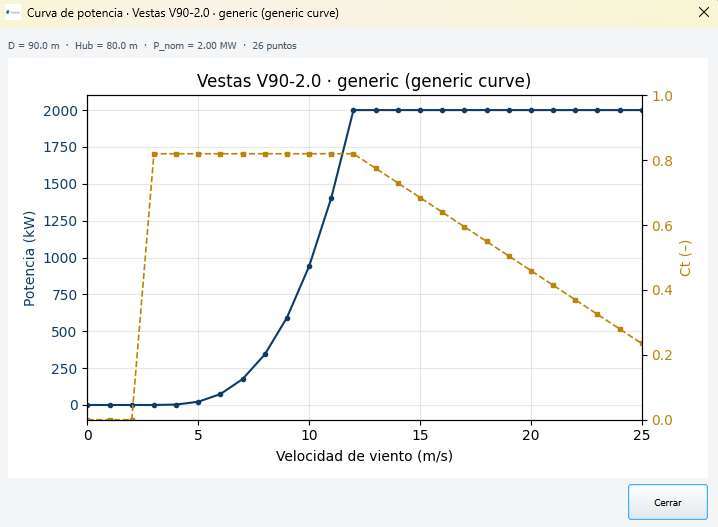
Layout, turbine model, power curve, wind resource type WAsP/WRG or compatible formats, PyWake inputs.
Modeling
PyWake-based calculation, with wake model selection, rotor-average, ambient turbulence, blockage correction.

Outputs
Total AEP, production per turbine, wake losses, sector analysis, wake maps, turbine layout on GIS.

Wind Farm Noise Assessment
The noise module allows you to evaluate the acoustic impact of a wind farm directly within QGIS, simulating source-to-receptor sound propagation according to ISO 9613-2 aligned models.


Inputs
Turbine layout, acoustic source groups, fixed LwA levels or LwA(ws) curves, receptors, terrain.
Modeling
Source-to-receptor acoustic propagation with fast engine or ISO-aligned octave-band engine.
Outputs
Raster noise maps, isophones, levels per receptor, critical receptor, comparison with limits.
Shadow Flicker Assessment
The shadow flicker module allows you to analyze the potential exposure of sensitive receptors to shadow flicker caused by wind turbines.


Inputs
Turbine layout, hub height, rotor diameter, receptors, lat/long, timezone IANA/DST.
Modeling
Annual solar geometry, civil local time IANA/DST or fixed UTC, shadow-receptor intersection.
Outputs
Shadow hours per receptor, affected days, daily maximum, threshold exceedances.
Download VelantisWind for QGIS
VelantisWind is available as an experimental QGIS plugin. We welcome feedback from the technical community to validate workflows against real wind farm projects and compare results with professional tools. Feedback on energy, noise and shadow flicker modules is welcome, including calculation assumptions, differences in outputs, receptors and visual layers.
Download the VelantisWind ZIP below and install it in QGIS.
Installation:
1. Open OSGeo4W Shell.
2. If PyWake is not already installed, run: python -m pip install py_wake==2.6.18
3. Restart QGIS.
4. In QGIS, go to Plugins → Manage and Install Plugins → Install from ZIP.
5. Select the downloaded VelantisWind ZIP and install.
Contact info@velantiswind.com for installation help.
Energy and Environmental Assessment in One GIS Environment
Velantis Wind is developing a free QGIS suite that brings together AEP calculation, acoustic evaluation, and shadow flicker analysis in a single open GIS environment.
Full QGIS Integration
This public experimental version brings together energy, noise and shadow flicker modules for technical testing, comparison with real project cases and community feedback.
Clearer Spatial Analysis
VelantisWind is an open-source QGIS plugin. You can review the source code, check the documentation, and contribute to its development on GitHub.
Enterprise Customizations
VelantisWind can be extended with custom modules, connections to internal data and workflows, calculation automation and tailored integrations.
Need to Adapt VelantisWind to Your Workflow?
In addition to the open development of the plugin, specific adaptations can be studied for companies, consultancies, or technical teams: new modules, custom input/output formats, report automation, integration with proprietary data, and connection with existing processes. Contact us to discuss a concrete adaptation or technical collaboration.
Documentation and User Guides
Explore the VelantisWind technical guides for step-by-step input preparation, calculation methods, assumptions, and results from each module.
Energy, AEP and Wakes — Learn how to configure the turbine layout, turbine model, wind resource and wake models to calculate wind farm energy production and aerodynamic losses.
Noise Assessment — Detailed guidance on acoustic inputs, sensitive receptors, terrain, atmospheric conditions and the fast and ISO-aligned propagation models.
Contact Us
Location
Calle Oeste N17
26005 Logroño, La Rioja, Spain
Email: info@velantiswind.com
Teléfono: [+34 681116732]